Structural Drying in North Richland Hills, TX
Structural drying means the framing, the bottom plates, the slab and the wall cavities are dry, not just the surface. The drying team maps the moisture, sizes equipment to each room and keeps it running until the readings meet the goal.
(888) 527-9134Get the drying started today in NRH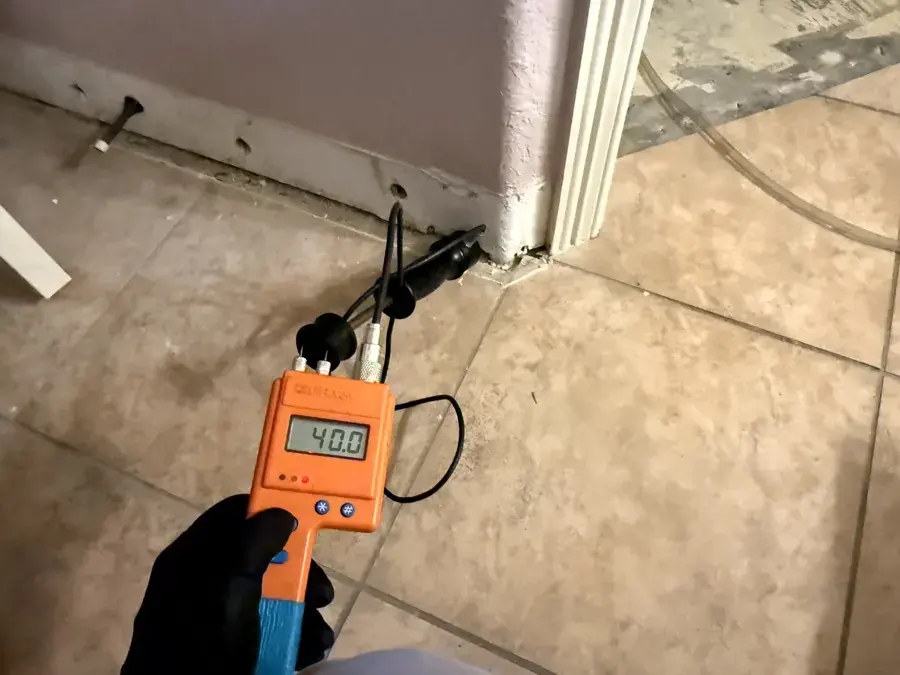
What to do first about structural drying in North Richland Hills
- Keep the house cool. Run the air conditioning; warm, humid air slows drying and feeds growth.
- Do not shut equipment off. Air movers and dehumidifiers are set for each room's load. Turning them off at night stretches the dry-out.
- Keep doors as set. The drying team closes some rooms on purpose so the dehumidifier works on that air.
- Empty nothing yourself. Most dehumidifiers pump to a drain. If one stops, call rather than moving it.
Why surface drying is not enough
Drywall can feel dry while the bottom plate behind it is still wet, and carpet can feel dry while the pad and slab are not. Those hidden pockets are where odor, swelling and growth show up weeks later.
On North Richland Hills slab homes, water runs under walls and cabinets, so the drying plan has to reach the cavities and the slab edge, not just the open floor.
What does structural drying cost in North Richland Hills, TX?
In North Richland Hills, TX, structural drying typically runs $1,000 to $6,000 or more depending on the number of rooms, the class of the loss and the days of equipment. A single Class 1 room is at the low end; a Class 3 or Class 4 loss with hardwood, plaster or a long-wet slab is at the high end.
Class 1 or 2, one area
- Moisture map
- Air movers and LGR
- Daily logs
Class 3, several rooms
- Wall cavity drying
- Additional dehumidification
- Psychrometric readings
Class 4, dense materials
- Desiccant dehumidifiers
- Mat systems
- Extended monitoring
For a planning range on your own rooms, use the water damage cost calculator. These are typical ranges, never a quote: the category of water, the square footage, the material class and how fast drying started set the real number.
How structural drying is handled in North Richland Hills
Map the moisture
The tech who does the walkthrough runs pinless meters and thermal imaging so the plan matches what is actually wet in the North Richland Hills home, not what looks wet.
Stop the source and extract
The extraction crew pulls standing water with truck-mounted extraction, so the water leaves the building instead of moving to the next room.
Set the drying system
Air movers go in at each room's evaporation load and LGR dehumidifiers pull that moisture out of the air; desiccants come in for dense Class 4 materials.
Verify dry and document
The drying team logs readings daily and pulls equipment only when wet materials sit within 2 to 4 points of a dry reference, then the file goes to the adjuster.
Class 1 through 4 decide the equipment
IICRC S500 groups losses by how much water is in the materials and how hard they are to dry. Class 1 is a small area with low-porosity materials; Class 2 is a whole room with carpet and wall wicking; Class 3 includes wet ceilings and insulation; Class 4 is dense materials like hardwood, plaster and concrete.
The class sets how many air movers and how much dehumidification each room needs, and when desiccants make sense.
- Air movers are set to the room's evaporation load
- LGR dehumidifiers handle most residential losses
- Desiccant units dry dense Class 4 materials and slabs
Daily readings and the drying goal
Every day the drying team records temperature and humidity in each room and outside, plus moisture readings at marked points on the wet materials. The goal is reached when those materials sit within 2 to 4 points of a dry reference material of the same type elsewhere in the house.
That record is the drying log adjusters expect, and it is why equipment leaves on readings, not on a calendar. The drying time estimator gives a rough planning range.
When to open a wall
Walls are opened when readings show water inside that cannot dry through small holes, when insulation is wet, or when the water was Category 3. Otherwise, directed air through drilled holes at the base often dries the cavity in place.
Structural Drying across North Richland Hills and nearby towns
The North Richland Hills restoration crew covers ZIP codes 76180 and 76182, the Smithfield and Iron Horse areas, HomeTown and the Davis Boulevard and Rufe Snow Drive corridors, plus Richland Hills, Haltom City, Hurst, Watauga and the rest of northeast Tarrant County.
The same service in nearby towns: Structural Drying in Richland Hills, Structural Drying in Haltom City, Structural Drying in Hurst, Structural Drying in Watauga, Structural Drying in Bedford, Structural Drying in Colleyville, Structural Drying in Keller, Structural Drying in Fort Worth, Structural Drying in Saginaw, Structural Drying in Euless.
See every town and ZIP code covered.
Further reading: EPA moisture control basics and Texas A&M AgriLife Extension.
Related water damage services in North Richland Hills
Structural Drying questions in North Richland Hills, TX
How long does structural drying take?
Most contained losses dry in three to five days. Hardwood, plaster, slabs and long-wet framing can take a week or more.
Why is the equipment so loud?
Air movers push large volumes of air across wet surfaces. The noise is temporary and the alternative is a slower dry with more damage.
Can I turn the equipment off at night?
It is better not to. Drying works continuously, and stopping lets humidity rise again in the closed rooms.
What is a dry reference?
A reading taken on the same kind of material in an unaffected part of the house. Wet materials are dry when they are within 2 to 4 points of it.
Why does the AC need to stay on?
Cool air holds less moisture and keeps the house comfortable while dehumidifiers pull water out of the materials.
Is structural drying covered by insurance?
It is usually part of a covered sudden water loss. Coverage depends on your policy, so it is worth checking with your own insurer.
Structural Drying in North Richland Hills? Start the dry-out now.
The response team answers 24/7 and sends the closest extraction crew with meters, pumps and drying equipment.
Call (888) 527-9134 now