Structural Drying in Watauga, TX
Standing water is only the visible part of a loss. In a Watauga house on a slab, moisture lingers in wall cavities, baseboards and the concrete surface, so the crew dries each of them to the IICRC S500 goal and logs the readings every day.
(888) 527-9134Wet walls or floors? Call to start drying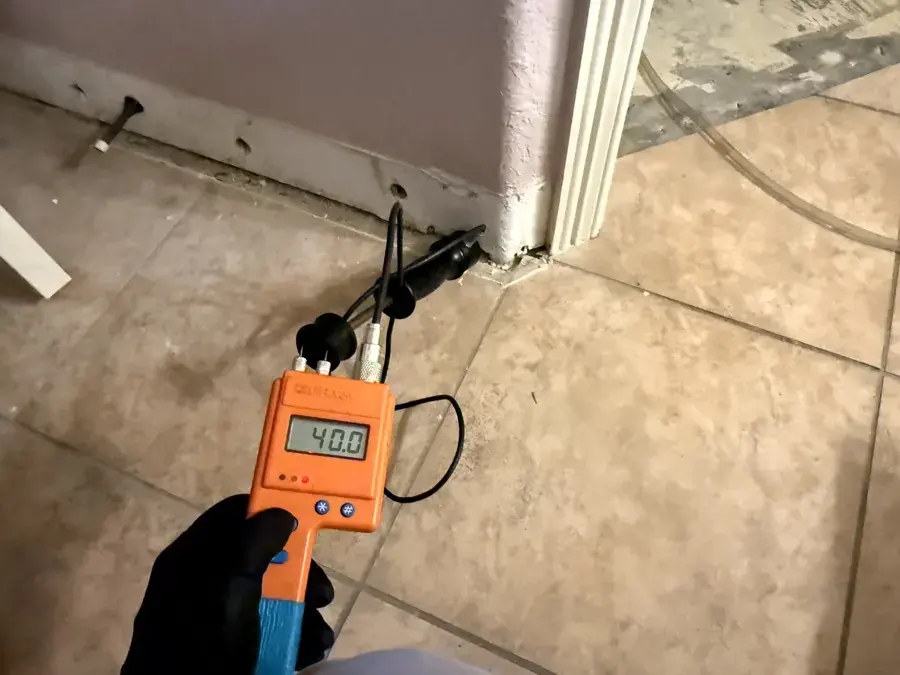
What to do first about structural drying in Watauga
- Stop and extract. Stop the source and remove standing water first, because every gallon taken out as liquid is a gallon the equipment does not have to evaporate.
- Do not turn up the heat. Heaters can drive moisture deeper into walls. Leave the thermostat alone, and keep doors between wet and dry rooms closed so humidity stays put.
- Note what is wet. Mark wet walls, floors and furniture with painter's tape or a note, since the crew will map them and a record of the first look helps.
- Keep the equipment on. Once drying equipment is running, leave it running. Switching it off early lets moisture settle back into framing and trim.
Why surface drying is not enough
In slab homes, water wicks into baseboards, the bottom plate and the lower few inches of drywall long before the floor looks wet. Those materials hold moisture that a dry carpet surface hides. The lowest few inches of a wall are usually the wettest.
With most homes now about 35 to 55 years old, trim, framing and finishes have been in place for decades and may include layers added over time. Each layer is metered because each one dries at its own speed.
What does structural drying cost in Watauga, TX?
Drying cost follows the drivers behind the North Richland Hills structural drying ranges: the number of rooms, the material class and how long equipment has to run. A contained loss on carpet sits low, and dense materials with a long exposure sit high.
Contained loss, one area
- Equipment in the wet room
- Daily moisture readings
- Short equipment run
Several rooms, wall cavities
- Baseboards and toe-kicks off
- Wall cavity drying
- Longer equipment run
Dense or long-wet materials
- Desiccant or mat systems
- Openings in walls
- Extended monitoring
For a planning range on your own rooms, use the water damage cost calculator. These are typical ranges, never a quote: the category of water, the square footage, the material class and how fast drying started set the real number.
How structural drying is handled in Watauga
Classify the loss
The crew sets the water category and the class from 1 to 4 based on how much material is wet and how dense it is, since those two decide the equipment.
Place the equipment
Air movers go where evaporation is needed, LGR dehumidifiers condition the air, and desiccants join in for dense Class 4 materials.
Open the cavities
Baseboards come off and small openings let air reach wet wall bottoms, which would otherwise stay damp long after the room feels dry.
Log and verify
Temperature, humidity and material readings go in a daily log, and equipment is pulled only when wet materials match a dry reference.
Class 1 through 4 decide the equipment
Class 1 is the smallest loss with little wet material, and Class 4 covers deep, dense and slow-drying materials such as concrete, plaster and hardwood. The class tells the crew how many air movers and dehumidifiers are needed and where.
On a slab, concrete often falls in the higher classes, because it holds water deep and releases it slowly.
- Class 1 and 2: carpet, drywall and trim
- Class 3: water coming from overhead
- Class 4: slab, hardwood and other dense layers
Daily readings and the drying goal
Each day the crew meters the same spots and records temperature, humidity and moisture. Equipment is repositioned as wet zones shrink and fans are re-aimed, so airflow always hits what is still wet, and dry areas stop getting attention.
The goal is within 2 to 4 points of the same material in a dry area of the house, and the log shows when each material got there. See slab leak water damage for a case where the slab sets the pace.
When to open a wall
Walls are opened when readings show water trapped in the cavity or when insulation holds moisture that airflow cannot reach. Small holes low in the drywall, or a short flood cut, let air in without removing more than needed. Drywall is cut out when it is soft or contaminated, and insulation that cannot dry is bagged, and the Watauga hub explains how this fits the other common losses.
Structural Drying across Watauga and nearby towns
Structural drying covers homes and businesses across Watauga, in ZIP 76148 and the 76137 part of town, including Watauga North, Watauga Northwest, City Center, the Whitley Road corridor and the US 377 corridor.
The same service in nearby towns: Structural Drying in Haltom City, Structural Drying in Richland Hills, Structural Drying in Keller.
Related water damage services in Watauga
Structural Drying questions in Watauga, TX
What does structural drying actually dry?
It dries materials, not only air: framing, bottom plates, drywall, trim and the slab surface. Surface drying leaves moisture inside, which is why meters direct the work. The same method applies to commercial and residential buildings alike.
How long will the equipment run?
Until the readings say it is done. A contained clean-water loss on carpet and drywall finishes before one in dense materials such as concrete or hardwood.
Why is the house noisy and warm?
Dehumidifiers and air movers run around the clock and give off heat, and warm dry air helps drying. The noise stops when the equipment is pulled. Ending early risks leaving moisture behind.
What is the dry reference?
A reading from the same kind of material in an unaffected part of the house. Wet materials are done when they come within 2 to 4 points of it.
Do walls always need to be opened?
No. Many walls dry through baseboard gaps and small holes. They are opened more when meters show water trapped in the cavity or in the insulation. A thermal camera helps decide where.
Is structural drying covered by insurance?
Drying after a sudden loss is often covered after the deductible. The daily logs show the work was needed and finished, so keep them with the claim file.
Structural Drying in Watauga? Start the dry-out now.
The response team answers 24/7 and sends the closest extraction crew with meters, pumps and drying equipment.
Call (888) 527-9134 now